
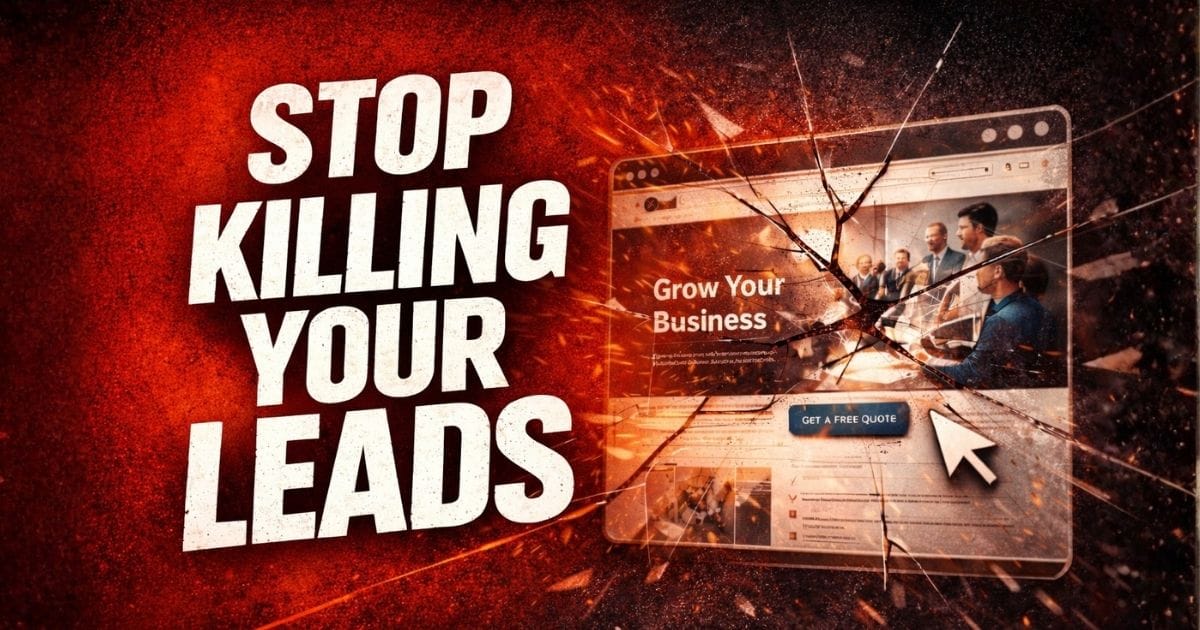
You’ve invested time and money into a beautiful website. The branding is sharp, the images are professional, and your services are clearly listed. You expected it to be a silent, 24/7 engine for new business inquiries.
But the reality is a quiet inbox. The phone rarely rings. That “Contact Us” form might as well be invisible.
This gap between a website that “looks great” and one that “gets results” is where most businesses falter.
Why Your Beautiful Website Isn’t Delivering
The core issue is a misunderstanding of a website’s primary function. While aesthetics matter – Triton Commerce notes that 75% of consumers judge a brand’s credibility based on its website design – a visually pleasing site is merely the entry ticket.
More Than Just a Pretty Face: The Deeper Issues with Lead Generation
True Lead Generation is powered by strategy, a seamless User Experience, and clear communication. A website that fails to generate leads is not just an underperforming asset; it’s a strategic liability, actively costing you potential revenue and market share. In fact, a staggering 90.7% of marketers use their websites to generate leads and sales, making its failure a critical business flaw.
Beyond Aesthetics: Shifting Focus from Looks to Conversion
Success requires a shift from treating your website as a digital brochure to seeing it as a dynamic conversion tool.
Every element – from the hero headline to the footer – must serve a purpose:
- attract the right audience
- communicate value instantly
- build trust
- guide visitors toward action
This conversion-centric approach transforms your website from a passive information hub into an active part of your sales process.
What You’ll Learn: Uncovering the Strategic Missteps and Actionable Fixes
This article breaks down seven critical mistakes that prevent websites from generating leads.
For each mistake, you’ll see:
- the problem
- its business impact
- clear, actionable fixes
The Foundational Flaw: When Your Business Website Lacks Strategic Purpose
The most significant reason websites fail is a lack of clear strategic purpose tied directly to business goals.
Many websites are built simply to “exist online” rather than to attract, engage, and convert a specific audience. This foundational flaw sets the stage for every other issue.
Your Website as a Strategic Asset (Not a Digital Brochure)
A digital brochure presents information and hopes for the best.
A strategic website is intentionally designed to achieve measurable outcomes.
Before design or development begins, you must answer:
- Who is the target customer?
- What problem are they trying to solve?
- How does your solution help?
- What action should they take?
Your website’s purpose should be the answer to these questions.
The Disconnect Between Design and Core Business Goals
When design is prioritised over strategy, the result is a site that may look impressive but fails commercially.
Examples include:
- animations that distract from CTAs
- minimalist layouts that hide critical information
- content focused on the company instead of the customer
If an element doesn’t support conversion, it adds noise.
Embracing a Lead Generation Mindset for Organisational Transformation
Treating your website as a strategic asset requires a cultural shift. It means moving from a “launch it and leave it” mentality to one of continuous improvement and data-driven decision-making. Marketing, sales, and even product development teams should view the website as a central hub for customer interaction and insight. This lead generation mindset is a form of organisational transformation, ensuring the website evolves with your business and your customers, remaining a relevant and powerful tool for growth.
Reason 1: A Vague Value Proposition (The “So What?” Challenge)
A visitor lands on your homepage. Within five seconds, can they answer the question: “What does this company do, and why should I care?” If the answer isn’t immediately obvious, you have a value proposition problem. This is one of the fastest ways to lose a potential lead.
The Problem: When Visitors Don’t Understand Your Unique Offering
Many business websites use corporate jargon and buzzwords. They also have self-praising statements like “market-leading solutions” or “innovative paradigms.” This language is vague and fails to communicate tangible benefits. A strong value proposition is a clear, concise statement that explains the specific benefit you provide, for whom you provide it, and how you do it uniquely well. Without this clarity, visitors are left confused and unmotivated.
The Impact: High Bounce Rates and a Stalled Sales Pipeline
Confusion leads to abandonment. When users can’t quickly grasp your value, they click the back button. This results in a high bounce rate – a key metric that signals to search engines that your page isn’t relevant. A vague value proposition pushes your site well above the average bounce rate, effectively stopping potential leads from ever entering your sales pipeline.
The Fix: Clarifying Your Message and Centring Your Customer
Refine your message to be ruthlessly clear and customer-centric. Lead with the outcome, not the process. Instead of “We leverage synergistic frameworks,” try “We help marketing teams double their leads in 90 days.” Use your homepage’s prime real estate – the headline and sub-headline in your hero section – to state your value proposition unequivocally. Test your message with real customers to ensure it resonates and immediately answers their “So what?” question.
Reason 2: The “Silent Killer” of User Experience (Navigational Chaos & Frustration)
A potential customer is interested in your solution, but they can’t find the pricing page. They want to read a case study, but the link is broken. They’re trying to view your site on their phone, but the text is tiny and buttons are unclickable. This is poor User Experience (UX), and it’s a silent killer of conversions.
The Problem: A Confusing Customer Journey and Poor Website Navigation
Poor UX manifests as illogical site structure, confusing menus, and inconsistent design. Visitors should be able to navigate your site intuitively, finding the information they need with minimal effort along their Customer Journey. When the path to conversion is littered with obstacles, users don’t persevere; they leave. The goal is to create a frictionless journey that guides the user from their entry point to the desired action.
The Impact: Frustrated Visitors and Eroding Customer Relationships
Frustration is an emotion you never want associated with your brand. A difficult-to-use website creates a negative first impression and erodes trust and valuable customer relationships. This poor experience has significant financial repercussions; bad UX can cost companies huge amounts in revenue annually as potential customers simply give up. Each frustrated visitor represents a lost opportunity and potential damage to your brand’s reputation.
The Fix: Designing for Seamless User Experience and Mobile-Friendly Access
Prioritise a clean, logical site architecture with clear navigation labels. Use heatmaps and user session recordings to identify where visitors are getting stuck – Microsoft Clarity is a free, easy to implement option for this. Most importantly, adopt a mobile-first philosophy by implementing a responsive design. With mobile devices driving nearly 60% of global website traffic, a responsive, easy-to-use mobile site is non-negotiable for a seamless User Experience.
Reason 3: Missing or Weak Calls to Action (The “Failing to Communicate” Website)
Your website clearly shows its unique value. It gives a great user experience. This convinces visitors that your website is valuable. However, once you’ve captured their interest, what’s the next step they should take? If your site lacks clear guidance on what actions visitors should perform next, you’re gambling with a critical stage of the engagement process. This lack of direction underscores a widespread flaw: having a call to action (CTA) that is either weak or missing altogether.
The Problem: Generic, Hidden, or Non-Existent CTA Buttons
A common mistake is using passive, generic CTAs like “Learn More” or “Submit.” These phrases lack urgency and fail to communicate the value of the action. Other websites hide their CTAs in the footer or use colours for the CTA button that blend into the background. The worst offense is having no clear CTA at all, leaving the visitor at a dead end after reading a compelling page.
The Impact: Lost Conversion Opportunities and a Stagnant Sales Funnel
Every page on your website should have a purpose and a corresponding next step. Without a clear call to action, you break the user’s journey. They might be ready to convert, but without a clear path forward, their interest wanes. This leads directly to lost leads and a stagnant sales funnel that never gets filled. You’ve done all the hard work of attracting and persuading a visitor, only to fumble at the goal line.
The Fix: Guiding Your Audience with Compelling and Personalised CTAs
Your CTAs should be action-oriented, benefit-driven, and highly visible. Use strong command verbs and specify the outcome. Instead of “Submit,” try “Get Your Free Quote Now.” Use contrasting colours to make your CTA button stand out.
Furthermore, consider a Personalised CTA based on the user’s stage in the buyer’s journey. A first-time visitor might see a CTA for an e-book, while a returning visitor on a pricing page sees “Start Your Free Trial.” This level of personalisation can significantly boost your Conversion Rate.
Reason 4: Low Trust and Credibility (The “Resistance to Conversion” Phenomenon)
Before a visitor will give you their email address, let alone their credit card number, they must trust you. A lack of trust signals – or, worse, the presence of trust-destroying elements – creates a powerful resistance to conversion. No matter how compelling your offer is, hesitation will win if credibility is low.
The Problem: When Visitors Don’t Trust Your Business or Its Claims
Trust is undermined by a variety of factors: an outdated design, spelling errors, no visible contact details, and a lack of social proof. An insecure website lacking an SSL certificate (HTTPS) is an immediate red flag. Visitors subconsciously look for signs that a business is legitimate. Much like how the Federal Court found that Samsung Electronics Australia Pty Ltd created misleading impressions with its water resistance claims, any False claims or untrustworthy elements on your site can destroy Stakeholder Trust.
The Impact: User Hesitation, Form Abandonment, and Lost Stakeholder Trust
When trust is low, users hesitate. They second-guess filling out a form, leading to high Form Abandonment rates. The impact extends beyond individual leads; a website that looks unprofessional can hurt trust with potential partners, investors, and future employees, harming your business in many ways. This hesitation is a major barrier in the Lead Funnel.
The Fix: Building Authority, Demonstrating Reliability, and Fostering Trust
Systematically build trust throughout your website. Display customer testimonials and logos of well-known clients. Showcase industry awards and security badges (like an SSL certificate). Provide a clear “About Us” page with photos of your team. Ensure your contact details, including a physical address and phone number, are easy to find. Every element of social proof and transparency helps dismantle skepticism and builds the confidence needed for them to convert.
Reason 5: The “Rigid and Inflexible” Website (Ignoring Evolving Customer Needs)
You launched your website three years ago and haven’t touched it since. In that time, your customers’ needs have evolved, your market has shifted, and your competitors have updated their digital strategies. A static website is a snapshot of the past, becoming less relevant with each passing day.
The Problem: A Static Website That Doesn’t Adapt to Customer Feedback or Market Changes
Many businesses treat their website as a one-time project. It’s built, launched, and then neglected. This approach ignores the dynamic nature of the digital marketplace. Your website should be a living entity, constantly refined based on performance data, Customer Feedback, and changing business goals. A “set it and forget it” mindset guarantees obsolescence.
The Impact: Decreased Engagement and Perceived Irrelevance
As your website’s content and functionality become dated, user engagement plummets. Visitors perceive your brand as out-of-touch or stagnant. They may find that your site no longer addresses their current pain points or that a competitor offers a more modern, relevant online experience. This leads to a gradual but certain decline in traffic, leads, and brand perception.
The Fix: Implementing a Culture of Continuous Optimisation and Responsiveness
Adopt an agile approach to your web presence. Regularly check website analytics. This helps you understand how users behave. Use A/B testing to optimise headlines, CTAs, and page layouts. Conversion Rate Optimisation (CRO) is the process that helps your website improve. It makes your website change to better meet your audience’s needs. This turns your website from a static relic into a lead generation machine that keeps getting better.
Reason 6: Performance and Technical Barriers (The “Outdated or Slow” Website)
A visitor clicks a link to your site and waits. One second. Two seconds. Three seconds. They’re gone. In the digital world, website speed is not a feature; it’s a fundamental requirement. Slow load times and technical glitches are impenetrable walls that block potential leads before they ever see your content.
The Problem: When Technical Issues Impede the User Experience
Slow page speed is the most common culprit, often caused by large image files, bloated code, or a slow web host. Other technical issues include broken links, non-functional forms, and compatibility problems across different web browsers. These issues create a frustrating and unprofessional experience that tells visitors you don’t care about their time or your digital storefront.
The Impact: High Abandonment Rates and Damaged SEO Rankings
The impact of poor performance is immediate and severe. If a website takes more than three seconds to load, a significant percentage of visitors will abandon it. This isn’t just a loss of potential leads; search engines like Google use page speed as a ranking factor. A slow site will be penalised with lower search rankings, reducing your organic visibility and compounding the problem.
The Fix: Prioritising Technical Health and Blazing-Fast Speed
Make website performance a top priority. Use tools like Google Analytics and other Website Analysis tools to diagnose and fix speed issues. Compress images, leverage browser caching, and invest in quality web hosting. Regularly conduct technical audits to find and fix broken links and other glitches. A fast, technically sound website provides a seamless experience that respects the user’s time and is favoured by search engines.
Reason 7: Neglecting SEO and Accessibility (The ‘Invisible & Unusable’ Website)
You can have the most strategically sound, beautifully designed, and technically perfect website in the world, but it will fail. If you ignore Search Engine Optimisation (SEO), people cannot find you. If you ignore accessibility, you exclude many potential users.
The Problem: Poor Search Visibility and Exclusionary Design
SEO is the practice of optimising your site to rank higher in search engine results for relevant keywords. Without a basic SEO strategy, your target audience will likely never find you online. Accessibility involves designing your website so that people with disabilities can use it. This includes providing alternative text for images, ensuring keyboard navigation, and using sufficient colour contrast.
The Impact: Missed Organic Traffic and Alienated Audiences
Without SEO, you are overly reliant on paid advertising or other channels to drive traffic, missing out on the highly valuable and sustainable stream of organic visitors. The impact of inaccessibility is equally severe. A staggering 97% of the top million home pages have accessibility errors, representing a huge opportunity for businesses that get it right. By neglecting this, you alienate a significant portion of the population and miss out on revenue.
The Fix: Integrating SEO Best Practices and Committing to Accessibility
Build a foundational SEO strategy. Research the keywords your customers use and create high-quality content that answers their questions. To make your website accessible, follow the Web Content Accessibility Guidelines (WCAG). Use semantic HTML, ensure all functionality is available from a keyboard, and test your site with screen readers. Doing both SEO and accessibility increases your reach. It improves the experience for all users. It also shows that your company is responsible.
Optimise Your Website To Generate Leads
A business website that fails to generate leads is rarely a failure of aesthetics, but a failure of strategy. These seven critical mistakes include a vague value proposition and poor technical performance. They all show a disconnect from the main goal of a commercial website. That goal is to attract, engage, and convert customers.
To transform your website from a passive digital brochure into an active lead generation engine, you must undergo a strategic shift.
- Purpose over Polish: Start with clear business goals and a deep understanding of your customer.
- Clarity over Cleverness: Communicate your value proposition instantly and guide users with obvious, compelling calls to action.
- Experience over Everything: Build trust and eliminate friction by prioritising a seamless, fast, and accessible user experience.
- Progress over Perfection: Commit to continuous improvement, using data and Customer Feedback to regularly refine and optimise your digital asset. Web Form Monitoring, for instance, can provide critical insights into user friction points.
While the average conversion rate across e-commerce sites is often under 2%, addressing these strategic flaws can place your business far ahead of the curve. Your traffic from paid ads, SEO, and social media deserves a destination that is built to convert. By fixing these foundational issues, you turn your website from a costly liability into your most powerful asset for sustainable growth.